Autonomous Experimentation and Sequential Learning
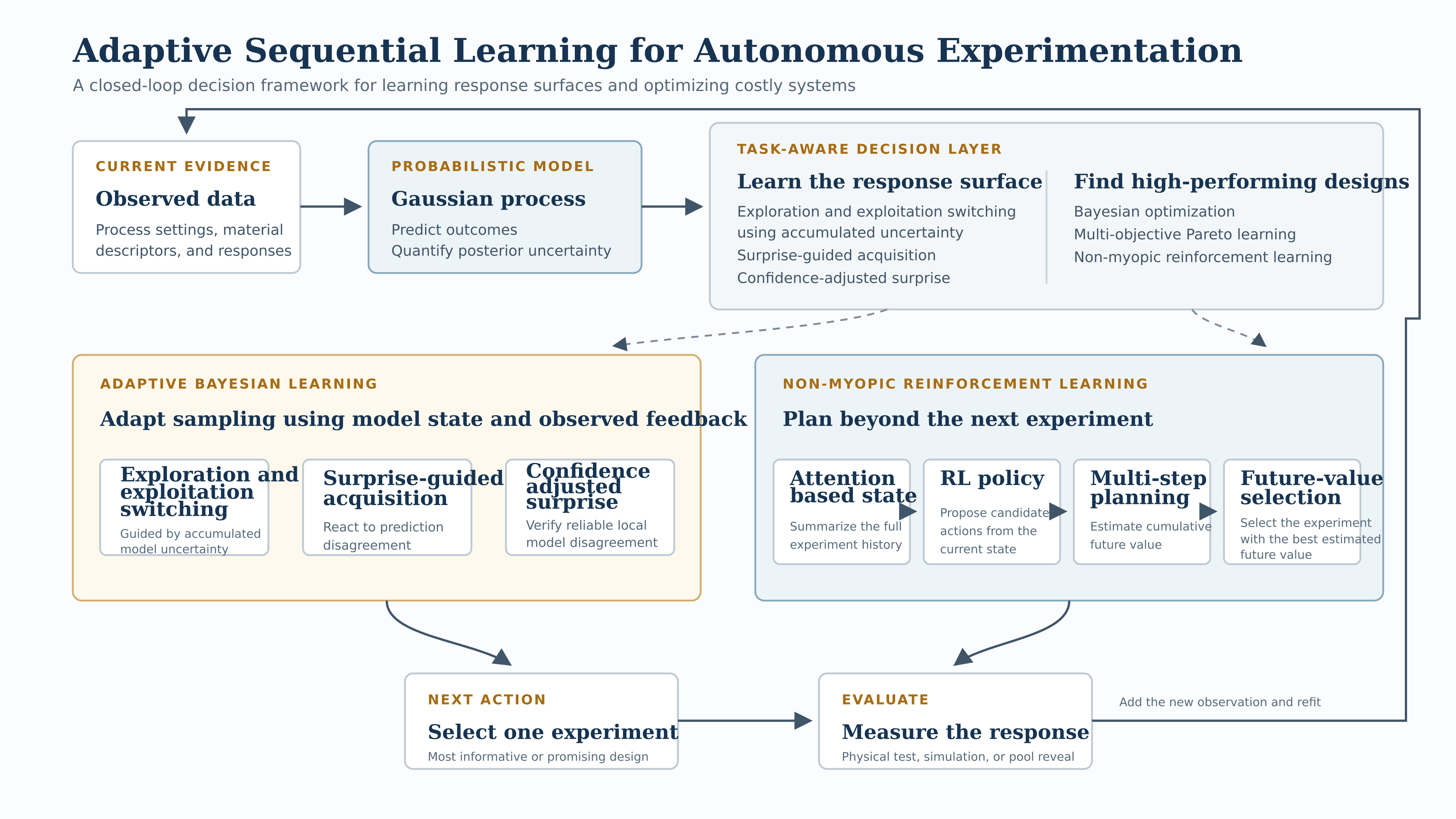
This research develops the computational decision engine of an autonomous experimentation platform: learn from the evidence collected so far, select the next informative or promising condition, obtain one new response, and adapt the policy under a limited budget.
Closed-loop framework for task-aware, resource-efficient autonomous experimentation.
Research goal
The goal is to use each costly observation intelligently. For response-surface approximation, the methods respond to evolving uncertainty, prediction-observation disagreement, and model confidence. For optimization, Bayesian methods search for strong single- or multi-objective designs, while the RL extension learns proposal behavior from cumulative finite-horizon rewards before one candidate consumes the next evaluation.
01
Adaptive Bayesian experimentation
A Gaussian process learns the unknown process-response relationship and quantifies what remains uncertain. Accumulated uncertainty is used to switch between exploration and exploitation instead of following one acquisition rule throughout the study.
02
Surprise-guided response-surface learning
Surprise-guided acquisition reacts when an observation disagrees with the current model. Confidence-adjusted surprise distinguishes a consequential disagreement in a well-supported region from an uncertain observation in an unexplored region. The policy can verify locally or return to global coverage.
03
Multi-objective sequential decisions
The multi-objective methods use GP surrogates and Bayesian acquisition rules to discover a Pareto set with fewer costly evaluations. This supports manufacturing problems in which improving one property may worsen another, so the decision is a trade-off rather than a single optimum.
04
Finite-horizon reinforcement learning
Non-myopic reinforcement learning uses inexpensive interactions with a Gaussian-process virtual environment to learn candidate-generation behavior over several possible future steps. An attention-based state representation summarizes the accumulated experiment history before the policy proposes new actions. Multi-step rollouts estimate the cumulative future value of the candidates. The experiment with the best estimated future value is selected for the next costly evaluation.