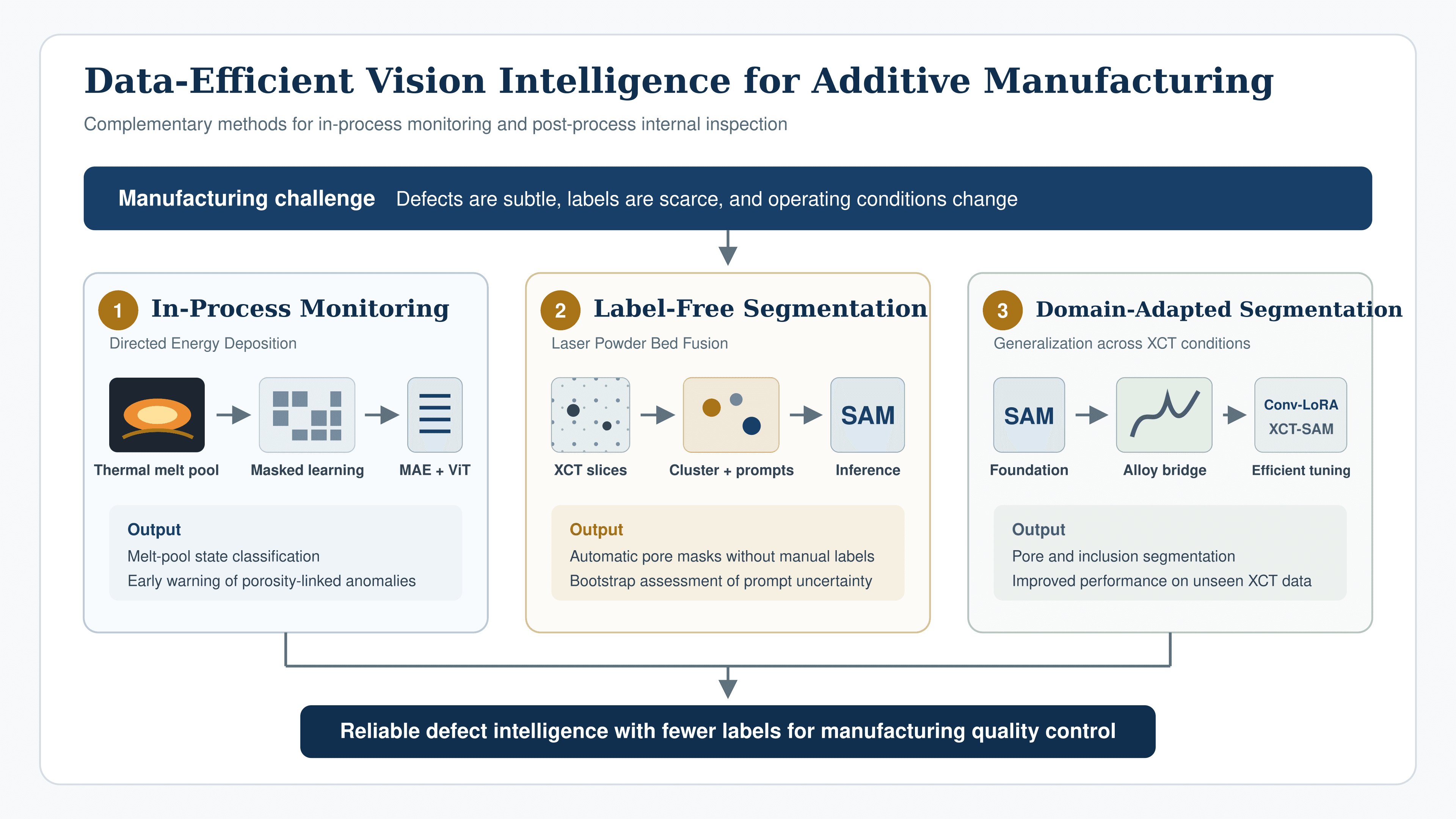
This research develops data-efficient vision methods for detecting and segmenting defects in additive manufacturing. It connects in-process thermal monitoring with post-process XCT inspection, while reducing dependence on large manually labeled datasets.
Research framework for data-efficient defect intelligence across the additive manufacturing lifecycle.
Research goal
Additive manufacturing generates large volumes of images, but reliable defect labels are expensive and often unavailable. Our work uses self-supervised learning, automated prompting, and parameter-efficient domain adaptation to learn from unlabeled data and limited annotations. The aim is to support earlier anomaly detection, accurate internal-defect localization, and more scalable quality assurance.
01
In-process melt-pool monitoring
Thermal images collected during Directed Energy Deposition are used to identify melt-pool conditions associated with porosity. A masked autoencoder first learns spatial representations from abundant unlabeled images. The learned encoder is then transferred to classifiers trained with a much smaller labeled dataset.
Key result: The vision-transformer models achieved 95.44% to 99.17% accuracy, with average F1 scores above 80%.
02
Label-free XCT porosity segmentation
For Laser Powder Bed Fusion parts, unsupervised clustering identifies representative XCT slices and automatically generates point prompts for the Segment Anything Model. This removes the need for manual prompt placement and supervised model training. Bootstrap resampling is used to examine the stability of the generated prompts.
Key result: The framework achieved Dice scores above 80% on its strongest samples without supervised fine-tuning.
03
Efficient adaptation of foundation models
XCT-SAM addresses the large gap between natural images and industrial XCT scans. The model is adapted first on alloy microstructure images and then on limited XCT data. Conv-LoRA modules add manufacturing-specific spatial information while the large SAM backbone remains frozen.
Key result: Only 0.647% of the model parameters are trained, while performance improves on synthetic and real out-of-distribution XCT datasets.