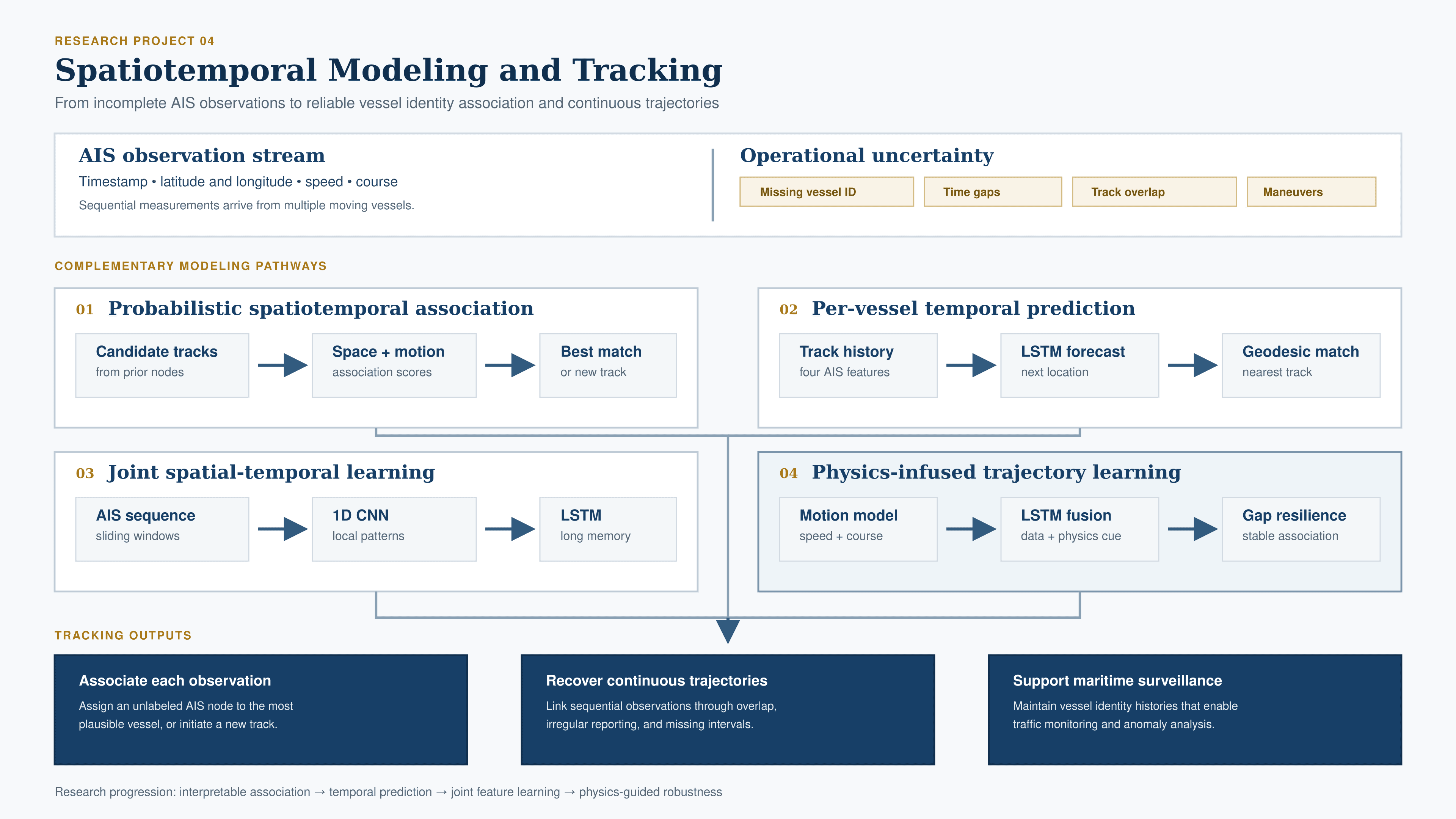
This research develops methods for reconstructing the identity and movement history of marine vessels from incomplete Automatic Identification System data. The central problem is track association: deciding which vessel generated each incoming observation when identifiers are unavailable, reporting intervals are irregular, or trajectories overlap.
Research framework linking interpretable association, temporal prediction, joint spatial-temporal learning, and physics-guided robustness.
Research goal
AIS records contain timestamps, vessel positions, speed, and course, but vessel identity can be missing or unreliable. The goal is to associate observations with the correct vessel, update its trajectory continuously, and remain accurate through time gaps, abrupt maneuvers, crowded ports, and overlapping routes. The research moves from transparent geometric rules toward learned sequence representations, then combines data-driven learning with physical motion cues.
01
Online spatiotemporal association
The first pathway associates each incoming AIS observation with an existing vessel track in real time. A geodesic motion model predicts plausible locations, a dissimilarity score compares the new observation with candidate tracks, and a spatially varying merge policy corrects unnecessary track fragmentation near ports or after long reporting gaps.
Key result: On an additional 186-vessel dataset, the method detected 182 vessels and outperformed the challenge baseline across the reported metrics.
02
Per-vessel temporal prediction
A bank of LSTM models learns the historical motion of individual vessels from latitude, longitude, speed, and course. Each model forecasts its vessel's next location. Haversine distance then compares an unlabeled observation with these forecasts and assigns it to the closest plausible track.
Key result: The study established a data-driven alternative to last-location-only motion models, while showing that overlapping trajectories remain difficult.
03
Joint spatial-temporal learning
The CNN-LSTM pathway treats track association as multivariate sequence classification. A one-dimensional convolutional network extracts local patterns from AIS windows, while the LSTM retains longer temporal dependencies before the classifier assigns the most likely vessel identity.
Key result: Across the full-scale comparison, CNN-LSTM achieved 0.89 accuracy, 0.89 precision, 0.91 recall, and a 0.89 F1 score, outperforming the tested CNN, LSTM, Bi-LSTM, Bi-GRU, and ANN models.
04
Physics-infused robustness
The physics-infused model combines a geodesic motion estimate with the temporal representation learned by an LSTM. The physics-based assignment is used as an additional input cue, allowing physical motion information and learned sequence patterns to compensate for one another when observations are incomplete.
Key result: The integrated model averaged 98.15% accuracy without added gaps and retained 92.69% accuracy when gaps were introduced, exceeding either standalone model in the reported experiments.